
06 — Sharing, follower apps and key management without lock-in
Esta página aún no está disponible en tu idioma.
2026-10-16 · investigation report · follows 03 — Nostr · spec: PROTOCOL-v2
Result
Section titled “Result”All of it works on emulators, end to end, across two independent implementations. A non-technical flow (scan a QR → both screens show the same 4-digit code → Allow) shares glucose without any secret ever being shown; removing a follower rotates the key while everyone else keeps going; a new phone restores everything from one password-manager entry and followers notice nothing. Real-phone tests with Proton Pass / Bitwarden are the remaining step.
Context
Section titled “Context”03 proved Nostr carries the data. It left the user-facing parts open, and the user asked for them:
- Follower apps, not just the Mac menubar — starting with Android.
- Password-manager integration for the keys — at least Proton Pass and Bitwarden — without lock-in (the user was explicitly worried that passkeys can’t be moved between managers).
- A non-technical way to share glucose with someone, and to stop sharing.
- Key rotation that keeps everything working without anyone re-doing setup.
- One app for both roles (closer to the final product) — without false positives: a follower must never look like it works because it reads the publisher’s local data.
Findings that shaped the design (research, with sources in the appendix)
Section titled “Findings that shaped the design (research, with sources in the appendix)”| Topic | Finding | Consequence |
|---|---|---|
| Password managers | Android Credential Manager password items work with Proton Pass (≥ 1.32), Bitwarden, Google Password Manager, KeePassDX on Android 14+; no domain / assetlinks.json needed; no length limit that matters |
Back up the identity key as a password item |
| Proton Pass quirk | Returns a saved item only to an app with the same signing certificate | Sign every build with one key |
| Passkeys | Need a domain + assetlinks.json; Bitwarden Android doesn’t return PRF; Proton Pass has no passkey export (CXP) yet → a passkey in Proton Pass can’t move to Bitwarden today |
No passkeys for now — exactly the lock-in the user feared |
| Group crypto (MLS / Marmot) | Mature-ish but every member must process every commit in order; followers (Mac, Home Assistant) can be offline for days | Not used: one shared read key, delivered privately per follower (gift wrap), rotated on revoke — the pattern of the open NIP-DA proposal (nips#2411) |
| Delegation / key migration NIPs | NIP-26 unrecommended; all migration NIPs unmerged | App-defined: identity key signs a roster of device keys |
| The 03 QR | It contained the read key → a screenshot = permanent access | v2 invites contain no secrets |
Design (PROTOCOL v2)
Section titled “Design (PROTOCOL v2)” identity key I ──(password manager backup) follower F (own key, per device) │ signs roster: devices=[D], epoch n ▲ │ seals key deliveries ──── gift wrap (NIP-59) ───────┘ {sid, epoch n, read key G_n, devices} device key D (phone) ── signs live + chunks, encrypted to G_n ──► relays ──► followers (accept only roster devices)- Share = owner shows a QR / sends a link with no secrets → follower app asks → owner taps Allow (both screens show the same 4-digit match code) → the read key travels privately to that follower only.
- Stop sharing = new read key epoch, delivered to everyone else; the removed follower gets nothing new.
- New phone = restore the identity from Proton Pass/Bitwarden → the app pulls its encrypted owner backup (followers, epochs, stream id) from the relays → new device key + new epoch → followers continue untouched.
- Missed a rotation = a follower that sees an unknown key id asks for it again; still-approved followers get it.
Reference implementation + end-to-end tests (Python, real public relays)
Section titled “Reference implementation + end-to-end tests (Python, real public relays)”poc/spikes/nostr/v2/: cgm2.py (protocol), nodes.py (owner / follower), scenarios.py.
(2026-10-19: nodes.py, scenarios.py and the CLI were retired with their cgmshare:join? links (investigation 24,
P15); cgm2.py keeps the primitives, and poc/spec/reference is the independent implementation.)
Every node has its own keys, own SQLite and own relay connections — the only shared thing is the public relays,
so a follower can only show data that really travelled through Nostr. Result: 19/19 checks pass
(results/v2-scenarios.txt):
| # | Scenario | Result |
|---|---|---|
| 1 | Share: request → approve → 12 h backfill + live | ✅ approved in ~1 s; 724/724 readings identical to the owner’s; every row records the relay it came via |
| 2 | Negative: owner denies a request | ✅ no key, 0 readings |
| 3 | Negative: forged key delivery (sealed by an attacker) | ✅ rejected — not sealed by the identity key |
| 4 | Negative: reading signed by a non-roster key | ✅ never delivered (subscriptions are roster-filtered) and rejected if a relay delivers it anyway |
| 5 | Revoke follower A while B keeps working | ✅ B gets epoch 2 and continues; A gets “access removed”, 0 new readings, its rekey requests refused |
| 6 | Phone change (restore identity only) | ✅ followers + stream restored from the relay backup; B continues on the new phone without re-inviting; readings signed by the old phone are rejected |
| 7 | Follower missed a rotation | ✅ asks for the key, gets it, recovers |
Bugs these tests caught (fixed, and written into the spec):
- Relay AUTH: relay.nostr.net and relay.damus.io only serve gift wraps after NIP-42 AUTH as the recipient. nos.lol, relay.primal.net, nostr.mom (and offchain.pub, nostr.oxtr.dev, snort, wellorder) serve them without.
- Same-second replacement: two versions of an addressable event in the same second → the second is rejected
(“replaced: have newer event”) → a stale owner backup.
created_atmust strictly increase perd. - A new follower must open its relay connections after reading the invite (it learns the relays from it).
Android app — “CGM Share”
Section titled “Android app — “CGM Share””poc/spikes/nostr/android-app (dev.spike.cgmshare, Kotlin, ~3.6k lines). One app,
two roles picked at onboarding — “I wear the sensor” / “I follow someone” — with separate databases, separate
Keystore keys and separate state files; only the chosen role’s engine is ever created.
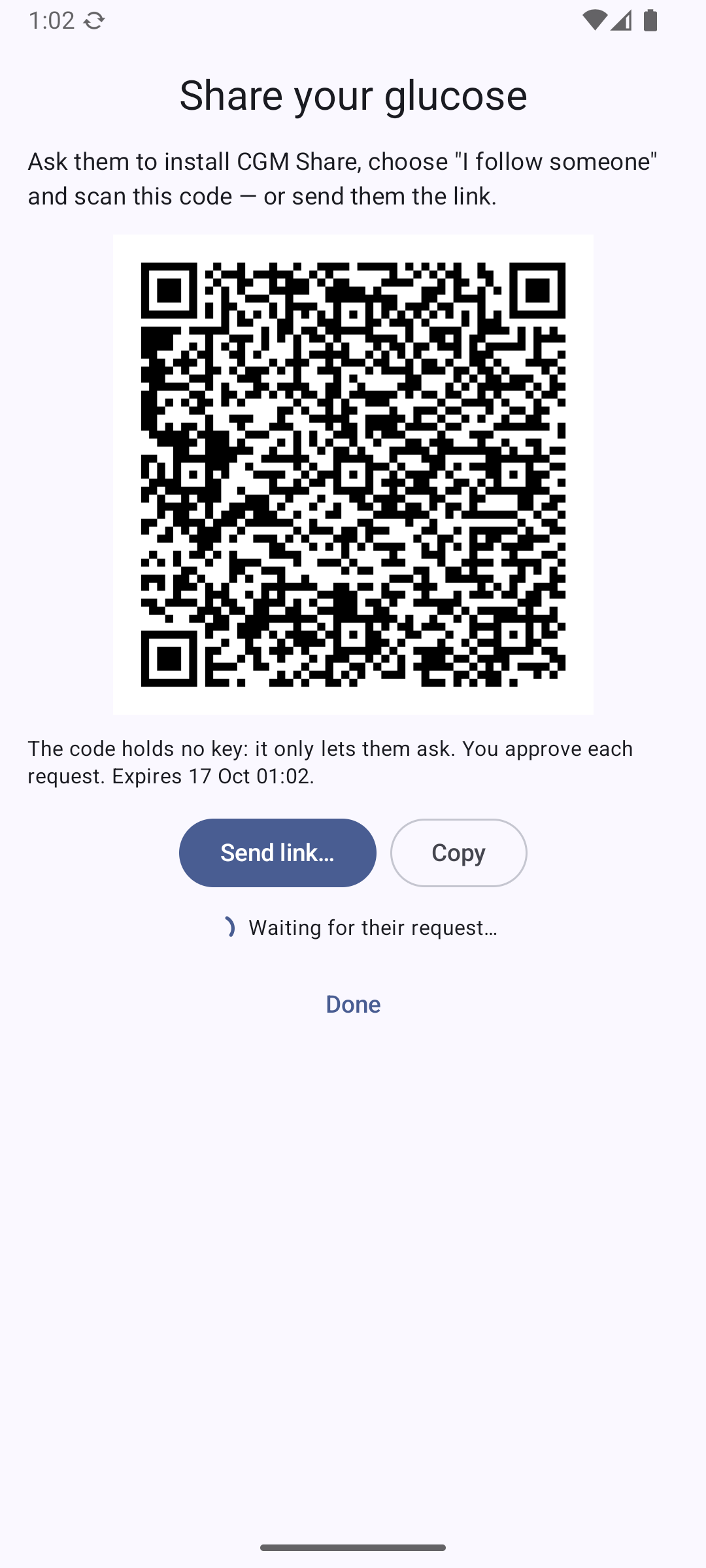
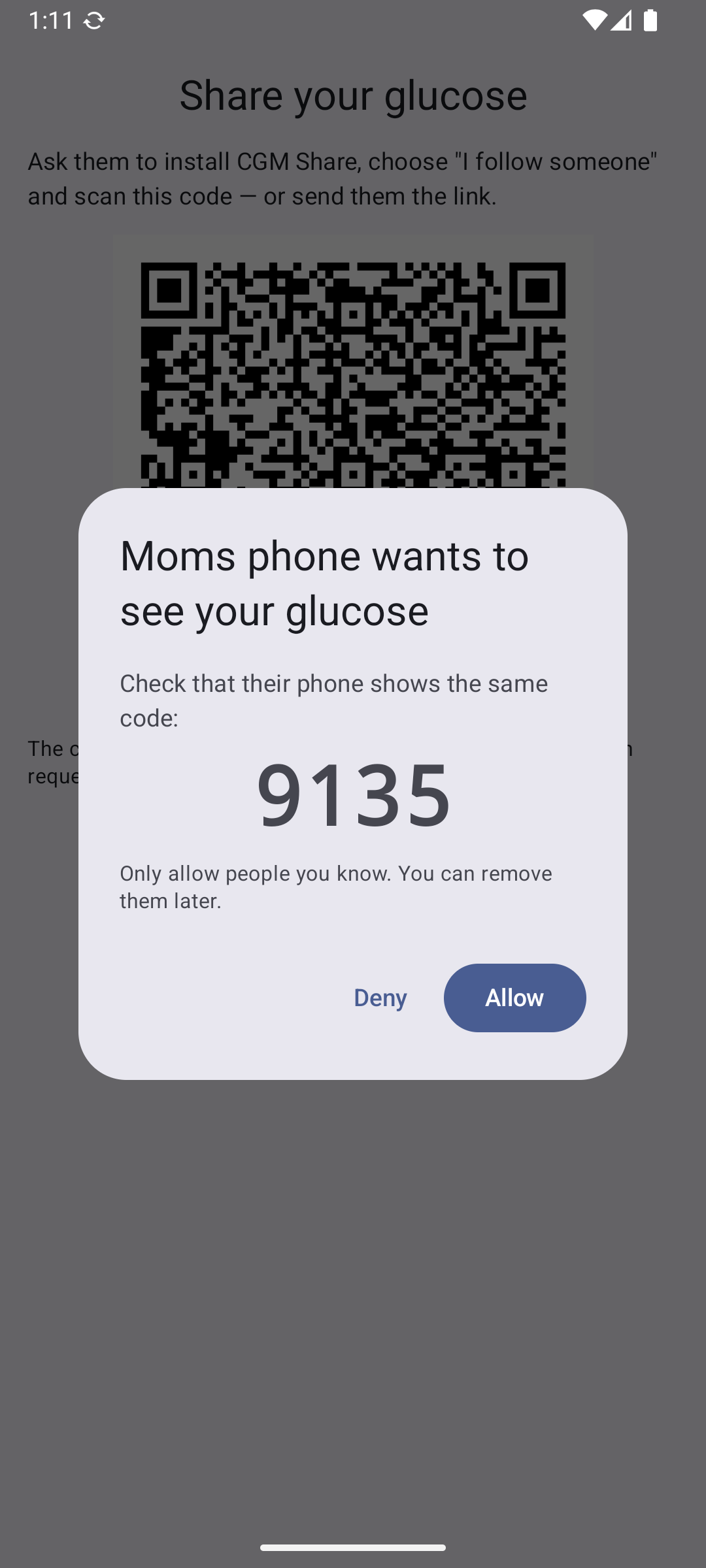
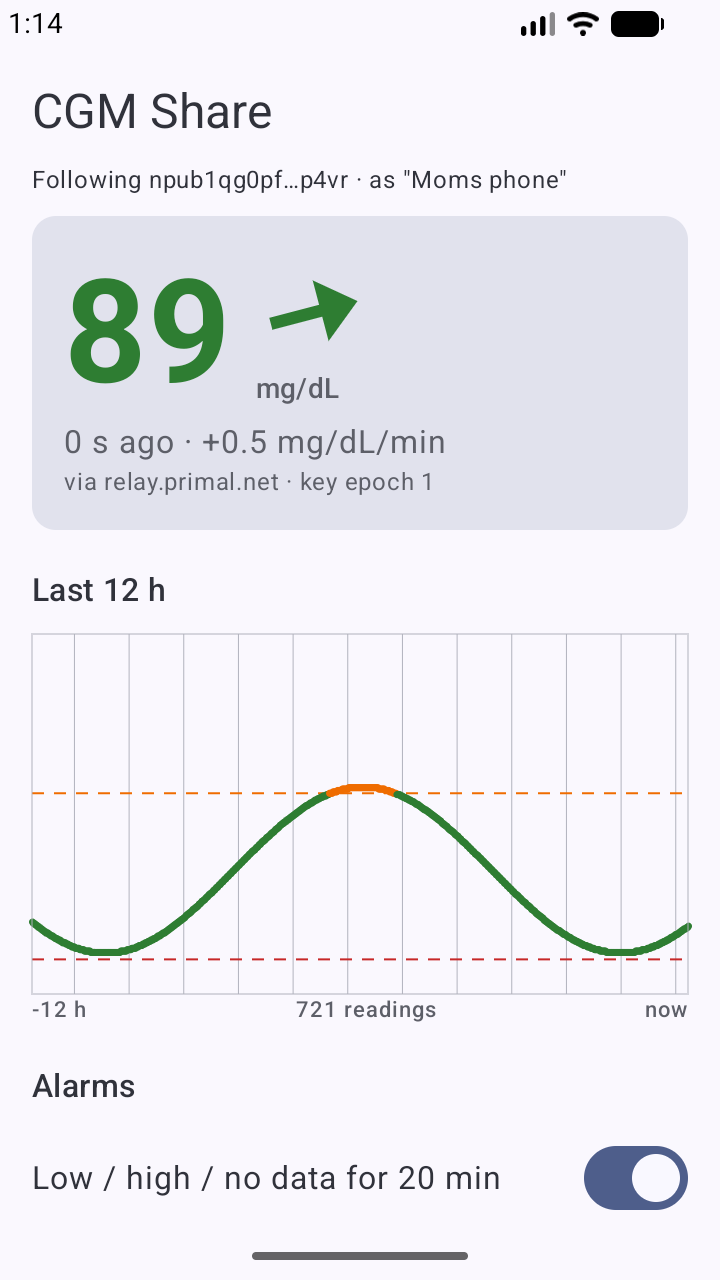
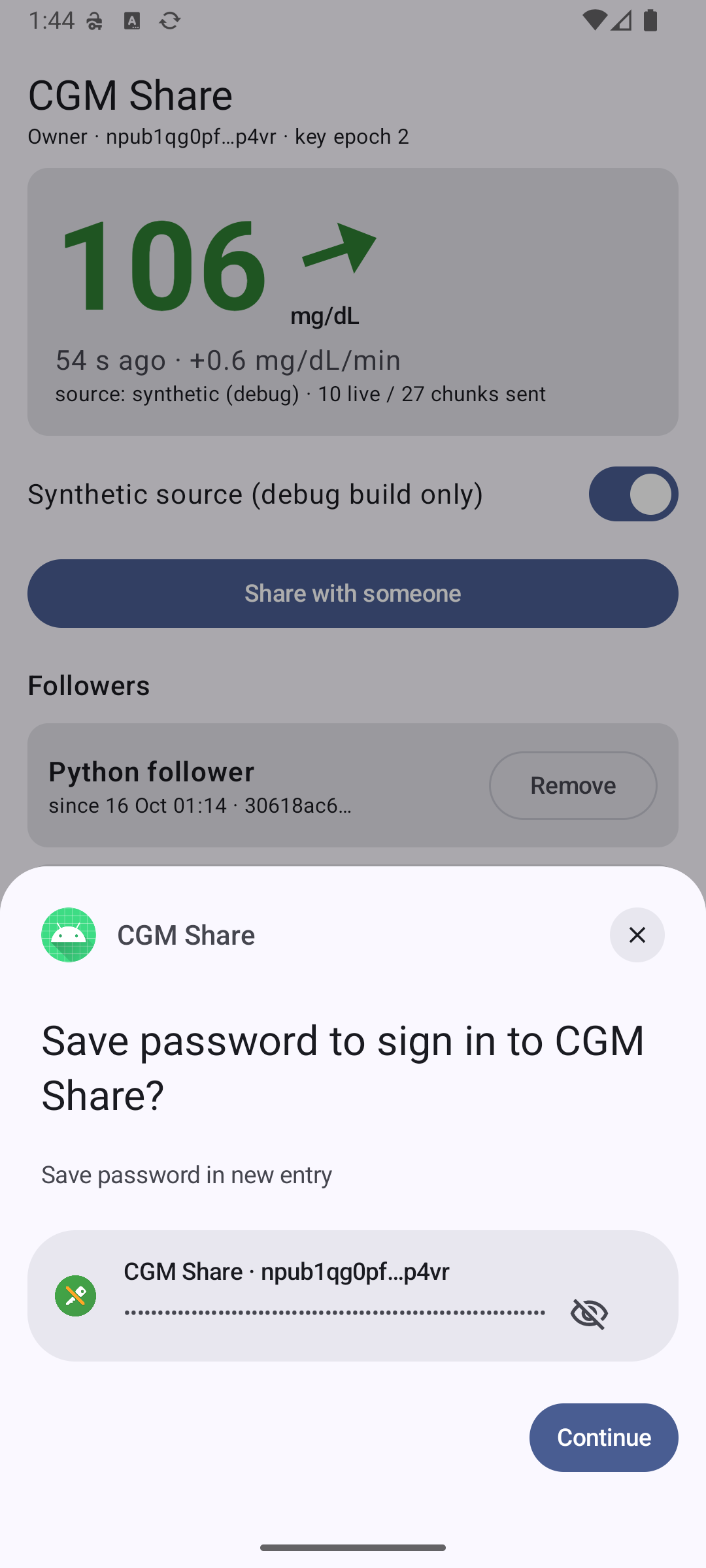
- Owner: Juggluco (or a debug synthetic source) → live + hourly chunks + roster + owner backup on 4 relays; Share (QR, share sheet, copy link); Allow / Deny dialog with the match code; followers list → Remove (full rotation); Save to password manager / Restore via Credential Manager (provider-agnostic, no Play Services), plus paste-nsec / NIP-49 “recovery code” fallback; Restore runs the phone-change flow.
- Follower: join by
cgmshare:link, paste, camera QR (CameraX + zxing-cpp, FOSS) or QR-from-image; waits with the match code; big number + continuous trend arrow + 12 h chart + “via relay X · key epoch n”; alarms: low/high (65/185) and no data for 20 min; “access removed” screen. - Transport seam for the next spike: both engines take events through one
onEvent(eventJson, via)with all acceptance rules behind it, and publish through aTransportinterface — Bluetooth will plug in next to the relays. - Library:
org.nostrdevkit:nostr-sdk0.45.1 (rust-nostr, renamed fromorg.rust-nostr) for keys/NIP-44/NIP-49/ NIP-59; own OkHttp relay layer (paced writes, subscriptions, NIP-42 AUTH). Release APK 14 MB (7.6 MB native lib).
Tested on two emulators = two separate devices (and against the Python reference); evidence in
android-app/evidence/:
| Scenario | Result |
|---|---|
| Share → join → approve | request reached the owner in 1.2 s; follower 720/720 readings identical to the owner’s 12 h |
| Negative: owner denies | follower stays “waiting”, 0 readings |
| Negative: forged key delivery | rejected: “not sealed by the identity key” |
| Negative: insider who knows the read key publishes live/chunk/roster from a non-roster key | 4× “author not in roster”, 1× “roster not signed by identity”, 0 forged values stored (with relay-side author filtering deliberately disabled to exercise the app’s own rule) |
| Revoke A, B keeps going | A got “access removed” in 0.2 s and nothing after; B (Python follower) moved to epoch 2 and continued |
| Phone change | cleared owner app data → restored from a password manager (KeePassDX) → same identity, new device key, epoch 3; app follower + Python follower continued without re-inviting, 719/719 identical, no gap |
| Password manager | KeePassDX as the emulator’s credential provider: Save and Restore work through the same API Proton Pass and Bitwarden implement |
| Cross-implementation | app follower ↔ Python owner: 770/770 readings equal; Python follower ↔ app owner: same match codes, epochs 1→2→3 |
| Alarms | “HIGH glucose” and “No glucose data” notifications fired |
Bugs the tests caught (fixed):
- The false positive the user worried about, for real: “Stop following” deleted the follower DB file under an open SQLite handle, so old readings stayed visible. Now the tables are cleared in place.
- Owner source never published (a name clash made the history handler recurse); QR-from-image decoded on the main thread (ANR); NIP-42 AUTH re-sent REQs in a loop; chunks lost if the app was killed mid-backfill.
- relay.nostr.net rejects AUTH (“relay needs serviceUrl”) → it can’t serve gift wraps; the other 3 relays can.
Battery-relevant choices: no polling, no WebSocket pings; owner wakes briefly per reading and checks for access requests when it publishes a chunk (~5 min); the follower keeps one inexact, idle-allowed alarm re-armed to “last reading + 6 min”, so it never fires while data flows.
Not done: Proton Pass / Bitwarden on the real phone (needs the user’s accounts), camera decoding on a real camera (only proven via “from image”), restart after reboot, real-phone Doze. Emulator latency numbers are inflated.
How the “false positive” worry is handled
Section titled “How the “false positive” worry is handled”- Owner and follower are separate devices in every test (two emulators; Python nodes with separate storage).
- The follower role has its own database and keys; each stored reading records which relay it came from.
- Negative tests must fail closed: denied requester, forged key, non-roster author, revoked follower — all show no (new) data.
- Two independent implementations (Kotlin app, Python reference) agree reading-for-reading in both directions.
- The worry was justified: testing found a real one (stale data after “Stop following”) — fixed.
Open questions / next
Section titled “Open questions / next”- 09 — Bluetooth as a second transport: the same signed/encrypted v2 events over BLE (private without relying
on BLE pairing), nearby pairing (request + match code + key over BLE, no QR, no internet), Android follower
and Mac menubar over BLE, and followers allowed to add treatments (roster
writers) that reach LibreView through the phone. - Proton Pass + Bitwarden save/restore on the real phone (needs the user’s accounts).
- Printable recovery sheet (NIP-49
ncryptsec+ generated passphrase) for people without a password manager. - Mac menubar + Home Assistant follower on v2 (today they still speak v1).
- Follower alarms on Android under Doze (unplugged, overnight) — and iOS (push gateway).
- Converge with NIP-DA if it gets merged.
Appendix: sources
Section titled “Appendix: sources”- Credential Manager: https://developer.android.com/identity/passwords · androidx.credentials 1.6.0
- Bitwarden Android credential provider (source); passkey asset-link issue https://github.com/bitwarden/android/issues/7451
- Proton Pass: Credential Manager passwords since 1.32.0; cert-bound app association (
StoredPasswordAppAssociationAuthorizer) - Passkey PRF support: https://www.corbado.com/blog/passkeys-prf-webauthn
- Passkey export (CXP): https://bitwarden.com/resources/july-2026-spotlight-your-passkeys-can-now-move-freely-heres-how/ · https://9to5google.com/2026/09/10/android-passkey-password-transfer/
- NIP-59 gift wrap https://github.com/nostr-protocol/nips/blob/master/59.md · NIP-49 · NIP-42 · NIP-DA proposal https://github.com/nostr-protocol/nips/pull/2411 · Marmot/MDK https://github.com/marmot-protocol/mdk