
01 — Getting live Libre 3 glucose onto a Mac, without the cloud
2026-10-15 · investigation report · code in poc/spikes/
Replace the current setup — an xbar plugin polling LibreLinkUp over the internet — with a macOS menubar item showing the glucose number and a precise trend arrow, with data that never leaves the user’s devices.
Questions:
- Can macOS read the FreeStyle Libre 3 sensor itself?
- Otherwise: can Juggluco on the phone send the data to the Mac without internet?
- Added during the investigation: it must also work with no shared network — Mac with no Wi-Fi at all, or Mac on home Wi-Fi while the phone is on mobile data. USB is not acceptable.
| Sensor | FreeStyle Libre 3 Plus (15-day wear), started 2026-10-03 |
| Phone | Pixel 10 Pro, Android 17 (SDK 37), rooted (KernelSU Next); Juggluco 11.4.1; GlucoDataHandler |
| Mac | macOS 27.0.1, Apple Silicon; Swift 6.4 (Command Line Tools only, no Xcode) |
| Units | mg/dL; personal thresholds low 65 / slightly high 145 / high 185 |
Results at a glance
Section titled “Results at a glance”| Path | Works? | Latency | Notes |
|---|---|---|---|
| Mac ↔ sensor directly (BLE) | ✅ proven | — | Phone must release the sensor; per-sensor pairing data from the phone; NFC still needed to start a sensor |
Juggluco web server → Mac over USB (adb forward) |
✅ | instant | Not practical (cable) |
| Juggluco web server → Mac over Wi-Fi | ✅ | ~0.3 s | Needs a shared network and Juggluco “Local only” off |
| Juggluco → GlucoBridge (phone) → Mac over BLE | ✅ | ~0.2–1 s | Works with Mac offline / phone on mobile data; 17/17 readings with phone unplugged + screen off |
| Bluetooth PAN tethering | ❌ | — | macOS 27 has no Bluetooth PAN support |
| Juggluco’s built-in “BLE mirror” | ⚠️ not built | — | Feasible but large, undocumented, moving target |
1. Can macOS read the Libre 3 directly?
Section titled “1. Can macOS read the Libre 3 directly?”Yes — but not as the everyday path.
- While Juggluco is connected, a BLE scan from the Mac (
poc/spikes/ble-scan) sees no Libre: the sensor stops advertising once a device is connected to it. - Juggluco (GPLv3) ships an open-source, portable implementation of the Libre 3 app-side protocol (since v10.10). It builds unmodified for macOS/arm64. On iOS, LibreLoop and Trio v1.0 already read Libre 3 natively; no macOS app existed.
- Experiment (2026-10-15 18:33): with the phone’s Bluetooth turned off, the Mac found the sensor after ~10 s, connected, authenticated using the pairing data Juggluco had stored for this sensor, and received two live 1-minute readings: 182 mg/dL, −0.24 and −0.32 mg/dL/min. Nothing was sent to the sensor beyond what’s needed to connect and subscribe. The phone was off Bluetooth ~75 s.
- Cross-check: when the phone reconnected, Juggluco backfilled the gap with exactly the same values
(evidence, rows
17310/17311: 182, 182 — backfilled rows carry no rate). Live data resumed with no loss.
Constraints that rule it out as the main path:
- One device at a time. While the Mac holds the sensor, the phone (and its alarms) gets nothing.
- A phone is still required to start each sensor (NFC — Macs have none) and to provide that sensor’s pairing data.
- Legal grey zone: the protocol implementation is a port of Abbott’s app logic. The experiment’s code is kept out of this public repo.
Possible future use: an emergency fallback when the phone is gone (dead battery, left at home).
2. Juggluco → Mac without internet
Section titled “2. Juggluco → Mac without internet”Juggluco has a built-in, Nightscout-compatible web server (Settings → Web server). Facts confirmed from its source and live:
- Port 17580 (HTTP), 17581 (HTTPS). “Local only” accepts the TCP connection and then resets non-loopback
clients — so over Wi-Fi it must be off; over USB (
adb forward tcp:17580 tcp:17580) it can stay on. - Optional API secret: header
api-secret: <sha1 hex of secret>, or?token=<secret>. GET /api/v1/entries.json?count=N— newest first. Default output is thinned to ~5 min; addinterval=0to get every 1-minute Libre 3 value.deltais the sensor’s rate × 5, not a difference between readings →rate = delta / 5(mg/dL/min). A missing rate is reported asdelta: 0withdirection: "".GET /x/live— Server-Sent Events: oneglucoseevent per new reading, pushed as soon as the phone gets it, withglucoseMgDlandrateMgDlPerMinute. Heartbeat every 20 s./x/stream— TSV with the per-minuteRatecolumn (handy for analysis).- Juggluco bug: “SingleDown” is never emitted — any rate ≤ −2 becomes “DoubleDown”. Use the numeric rate.
- The Nightscout uploader can also POST to any plain-HTTP LAN URL (must answer exactly HTTP 200) — a push alternative.
Rate precision: the sensor reports the rate with 0.01 mg/dL/min resolution; in a 5 h sample 98 % of values were
non-integer (short runs of exact 0 occur). Enough to draw a continuous arrow.
Wi-Fi results (poc/spikes/menubar, “auto” mode):
- Juggluco has no mDNS/Bonjour, so GlucoseBar sweeps the Mac’s subnet for
:17580and checks/api/v1/status.json→ found the phone in ~1 s on a /24. - History via
entries.json?count=180&interval=0, then live via/x/live: ~0.3 s from the phone receiving a reading to the Mac showing it. - After the phone’s Wi-Fi came back from an outage, GlucoseBar rediscovered the phone by itself.
- A macOS
.appneeds the Local Network permission for this.
3. With no shared network
Section titled “3. With no shared network”| Option | Mac offline | Mac Wi-Fi + phone mobile data | Verdict |
|---|---|---|---|
| Phone hotspot | ✓ (Mac joins it) | ✗ (one Wi-Fi radio) | Partial |
| Bluetooth PAN tethering | — | — | macOS 27 dropped it (no “Bluetooth PAN” port, no driver) |
| Tailscale / VPN | ✗ | ✓ | Needs internet |
| Juggluco “BLE mirror” | ✓ | ✓ | Mac would have to speak Juggluco’s mirror sync protocol (handshake + session crypto + acking its internal file-sync stream). ~1–1.4k lines of Swift against an undocumented protocol that changed several times in 2026. Rejected. |
| Companion app + BLE GATT | ✓ | ✓ | Chosen |
GlucoBridge (poc/spikes/glucobridge-android, Kotlin)
Section titled “GlucoBridge (poc/spikes/glucobridge-android, Kotlin)”A foreground service on the phone that:
- follows Juggluco on
127.0.0.1:17580(so “Local only” can stay on), and - runs a BLE GATT server + advertises a custom service. The Mac (CoreBluetooth central) connects, reads a 3-hour per-minute history once, and subscribes to reading notifications.
| Characteristic | UUID | Properties | Value (little-endian) |
|---|---|---|---|
| service | 6c1f0001-5b8a-4d8e-9a3c-676c75636f42 |
||
| READING | 6c1f0002-… |
read, notify | u32 epoch s ‖ u16 mg/dL ‖ i16 rate×100 (0x8000 = unknown) |
| HISTORY | 6c1f0003-… |
read (long) | u32 newest epoch s ‖ u16 mg/dL per minute, newest first (180 slots, 0 = gap) |
| Test | Result |
|---|---|
BLE only (GlucoseBar -lan NO) |
Found GlucoBridge in 3 s; every reading ~0.3 s after the phone |
| Phone Wi-Fi off (phone on mobile data, Mac on home Wi-Fi) | Wi-Fi transport dropped; BLE delivered every minute (19:03–19:05, ≤ 1.2 s) |
| Phone unplugged + screen off, 19:08–19:25 | BLE 17/17 readings, 0 missed, worst 0.2 s, never disconnected |
| Both transports at once | Same reading arrives twice (BLE ~1 s earlier); the app merges them |
Raw log: evidence/01-transport-tests.log. (Wi-Fi readings stop at 19:12 because “Local only” was switched back on — not a failure.)
Not yet validated: deep Doze (phone unplugged and still > 30–60 min), Mac sleep/wake, Mac with Wi-Fi truly off
(simulated with -lan NO), range, long-term reconnect behaviour.
Gotchas:
- Android’s
BluetoothGattServerCallback.onConnectionStateChangealso fires for the phone’s own outgoing links (the sensor, a watch), so “connected centrals” is noisy — count subscriptions instead. - The GATT service is unauthenticated: anyone nearby can read the value. Real app: encrypted characteristics with bonding, or an app-level key exchanged once (QR).
4. Menubar UI (GlucoseBar)
Section titled “4. Menubar UI (GlucoseBar)”
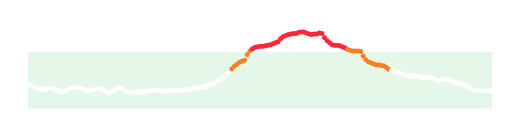
- Arrow: drawn in code (template image, so it follows light/dark menubar). Angle = rate / 3 mg/dL/min × 90°, clamped; a second chevron at ≥ 3 mg/dL/min. Keeps Libre’s bucket centres (±1.5 → 45°) but shows 0.4 vs 0.9.
- Rate source, in order: the sensor’s own rate → least-squares slope over the last 15 min → Nightscout direction.
- Colour: red < 65 or > 185, orange > 145. Stale (> 5 min): dimmed + strikethrough.
- Dropdown: value + rate, reading time and age, a 3 h sparkline, which transport delivered the latest reading.

Decisions
Section titled “Decisions”- Mac app: BLE central to the phone app is the primary transport; Wi-Fi to the phone is secondary; both merged.
- Phone app (future Juggluco replacement, Kotlin): owns the sensor and serves the Mac over BLE GATT. GlucoBridge is its seed — only the data source changes.
- Don’t build on Juggluco’s BLE mirror. Keep “Mac reads the sensor directly” only as a possible fallback.
Open questions / next PoCs
Section titled “Open questions / next PoCs”- PoC 2: the phone app reads the sensor itself instead of Juggluco (test by force-stopping Juggluco).
- Sensor start / switch-receiver from the own app (NFC).
- Secure the BLE link (bonding or app-level encryption) and pairing UX between phone and Mac.
- Deep-Doze soak (phone unplugged ≥ 1 h), Mac sleep/wake, range, reconnects after Bluetooth toggles.
- Backfill on the Mac after sleep (HISTORY covers 3 h — enough?).
- Define the full feature list for the real apps (alarms? multiple Macs? watch?).
Toolchain notes
Section titled “Toolchain notes”- adb:
brew install --cask android-platform-tools. - Android CLI (Google’s CLI for agents):
curl -fsSL https://dl.google.com/android/cli/latest/darwin_arm64/install.sh | bash, thenandroid init. Used forandroid create empty-activity,android run --apks … --install-options=-g,android screen capture,android docs search. It installs SDK packages on demand into~/Library/Android/sdk. - JDK 17 (AGP 9 requirement):
brew install openjdk@17, thenexport JAVA_HOME=$(brew --prefix openjdk@17)/libexec/openjdk.jdk/Contents/Home. - Swift spikes build with Command Line Tools only (
swift build);bundle.shwraps GlucoseBar into an ad-hoc-signed.app(LSUIElement, Bluetooth + Local Network usage strings). - macOS formats times with a narrow no-break space before AM/PM (
U+202F) — remember it when parsing logs.
References
Section titled “References”- Juggluco — https://github.com/j-kaltes/Juggluco · https://www.juggluco.nl/Juggluco/libre3/
- LibreLoop — https://github.com/LoopKit/LibreLoop · Trio v1.0 — https://github.com/nightscout/Trio/releases/tag/v1.0
- RoundWhiteDiscKit — https://github.com/airedev326/RoundWhiteDiscKit
- DiaBLE (archived) — https://github.com/gui-dos/DiaBLE
- Android CLI for agents — https://developer.android.com/tools/agents
- 37 CFR 201.40(b)(7) (medical device data exemption) — https://www.law.cornell.edu/cfr/text/37/201.40